
A tree needs to grow for twenty to fifty years before it can be cut down and used for timber. The trunk then needs to be excavated through the roots, and the tree needs to be replanted from a new seed—which requires energy, resources and importantly, money.
But one other sustainable material could solve this problem, by not requiring farmers to plant or sow seeds. That material? Bamboo.
Bamboo generates from rhizomes, which produce shoots and culms that enable the plant to regrow from the same spot once one stalk is cut down.
Bamboo also grows rapidly—within three to five years, it is fully-grown and ready for harvest, with some strands reaching maturity within five to seven years. This renewability makes bamboo widely available: a more sustainable building material than timber.

One second-year M.S. student in UT Austin's Sustainable Design program, Dakshata Kishor Koli, has the perfect idea for how to use bamboo’s properties to the fullest: to revolutionize sustainable and affordable housing in flood-prone regions. Yet Dakshata faces an ongoing struggle to convince her contemporaries of bamboo’s viability as a building material.
“People still think that this material is a ‘poor man’s timber,’” Dakshata said. “It is changing I feel, but it is a really, really slow road compared to other materials on the market.”
Designing for Disaster
There are many emergency shelter proposals being presented all over the world as flooding and flood risk are increasing in many regions. Low-lining, rural communities in South Asia bear the brunt of the impact and are gradually disappearing as residents try to avoid disasters by migrating to urban areas.
“In post-disaster scenarios, there is less of a housing situation,” Dakshata said. “The government has to convert public spaces into shelters post-disaster until their original housing is restored.”
The key is to build temporary housing with affordable, easily accessible materials, which will give rural communities the ability to construct or reconstruct their own homes without relying on external assistance.
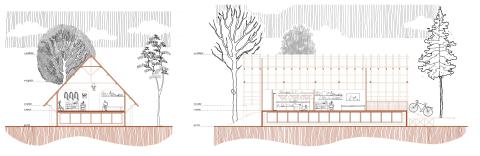
“Whenever there is a disaster, the community is prepared to work or build a house on their own,” Dakshata said. “The community can reduce their dependence on external assistance by using locally available materials and construction methods that enable them to build and rebuild housing more independently.”
Disasters occur in three phases. Housing might be built pre-disaster, to prepare for upcoming or potential floods; during a disaster, to provide emergency shelter, or post-disaster, to reconstruct lost or devastated homes. Dakshata is especially concerned with pre-disaster and post-disaster housing.
Dakshata must also consider whether she is dealing with a disaster that impacts people over the short-term or long-term. A short-term disaster, such as an earthquake, can destroy infrastructure in minutes, while a long-term disaster, such as sea level rise, gradually impacts communities over a long period of time.

Dakshata has designed housing intended to survive the short-term threat of flash flooding and to withstand the long-term threat of rising sea levels.
“Globally, sea level rise is already happening,” Dakshata said. “My focus is on South Asian countries. As an architect, I feel it's my responsibility to take this very seriously in this changing climate.”
Dakshata’s design offers a permanent housing solution to communities under threat of flood, to be built before a flood even occurs. Her proposal positions bamboo buoyant blocks under the home. These square cubes, one meter in length, are made up of bamboo framing and recycled plastic bottles. The cubes allow the house to float on rising waters, while still being anchored to the building site.
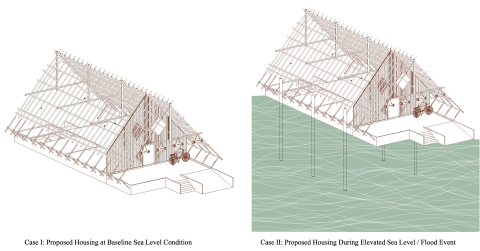
“Whenever there is a short-term disaster, like flood, or long-term disaster, like sea level rise, the house will rise on its own,” Dakshata said. “And the house will be anchored on the site, so that it is not waved away with the water, and there is just upward movement happening.”
Dakshata's emergency shelter design for post-disaster scenarios is reliant on a prefabricated model. Her design ensures quick and simple construction when residents lose their homes after a flood. The walls, roof and flooring will be constructed in pieces at a factory, similar to pre-cast concrete construction. Then the pieces will be shipped to the site of the lost home in sections and built on-site within a day or a few hours.
“People can just assemble it like LEGO onsite,” Dakshata said. “And they will have their home for a temporary stay. When their original house is restored, this house can be dismantled, taken back to the factories and reused for another disaster.”
Up to the Challenge
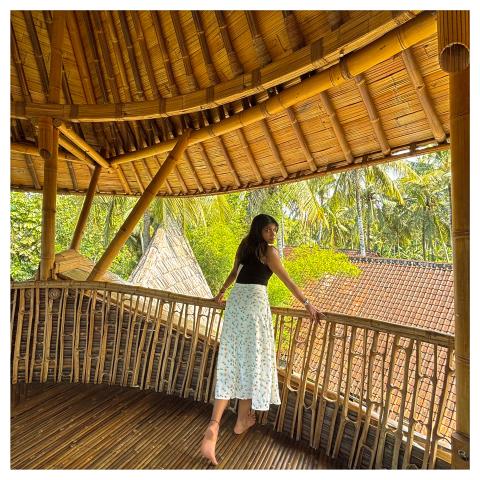
Dakshata Kishor Koli grew up in a rural township on the outskirts of Mumbai, India. While pursuing her undergraduate degree in architecture in Mumbai, her professors were surprised when she chose the topic for her undergraduate thesis project: “Disaster Resilient Housing in Sundarban, India.” But Dakshata—who never takes “no” for an answer—was up to the challenge.
“When final review happened, and everything came together, they were impressed with my work,’” Dakshata said. “And that was my moment that ‘Okay, I proved you wrong.’”
Dakshata spent two years practicing as a junior architect, but her mind kept drifting back to her undergraduate thesis project. She decided to pursue a master's degree in sustainable design at UT, where the low faculty-to-student ratio would ensure close mentorship, and where she could engage with real-world sustainability challenges in the dynamic living lab of Austin.
“What I most appreciate about my graduate program is its strong emphasis on combining rigorous research knowledge with creative, real-world application,” Dakshata said. “The program encourages experimentation, critical thinking and interdisciplinary collaboration, allowing me to explore innovative solutions in sustainability while staying grounded in practical design.”
Building the Future at UT and Beyond
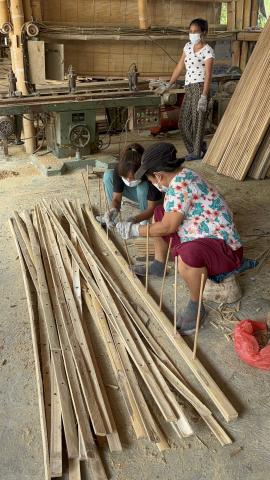
In 2025, Dakshata was awarded an International Travel Research Scholarship from the School of Architecture, which allowed her to travel to Indonesia. This crucial funding enabled her to explore not only the theoretical aspects of sustainable architecture, but the practical applications of bamboo as a construction material.
“It was an in-person experience of visiting bamboo factories and seeing the process of treatment,” Dakshata said. “There are a few quick treatments, which I came across in Indonesia, which involve a boron-based compound. The solution involves mixing a 10% concentration—comprising 4% boric acid and 6% borax—in 90% water and soaking the bamboo for seven days.”
Borax, which is a naturally occurring salt, acts as a preservative, allowing the bamboo to resist insect and fungal attacks. While its primary role is to improve durability, its effects on mechanical properties such as compressive, tensile and bending strength can vary depending on the species and treatment method, making it a widely used approach to enhance the performance of this natural material.
On her research trip, Dakshata had the opportunity to discuss this process with a local architect from one of the top firms in Indonesia.
“It was a long conversation and was very fruitful for me and for my research as well,” Dakshata said. “He talked about many practical problems when it comes to the maintenance. It’s an issue, but at the beginning, if you invest in the treatment, it can be beneficial for you over years.”
On her trip, Dakshata was inspired by the ways in which Indonesian architects are able to improve bamboo’s durability and reliability in environmentally friendly ways that utilize its structural properties to the fullest.
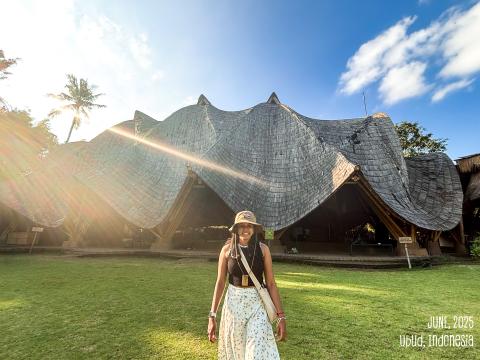
“There is one perception that what we call ‘a bamboo house,’ people look at as low-income family housing,” Dakshata said. “In Indonesia, they have explored the full potential of the bamboo They aim to make it weather-resistant and last for years. And it’s aesthetically pleasing.”
This research trip enhanced Dakshata's academic and professional growth, and strengthened her research capabilities, inspiring her to experiment, think critically and collaborate even after her graduate degree is over and better serve communities in disaster-prone regions.
“By combining traditional knowledge of bamboo construction with modern engineering techniques, we can create affordable housing that is not only environmentally friendly but also safer and more adaptable for vulnerable communities,” Dakshata said. “There is so much power in architecture to change the world.”